

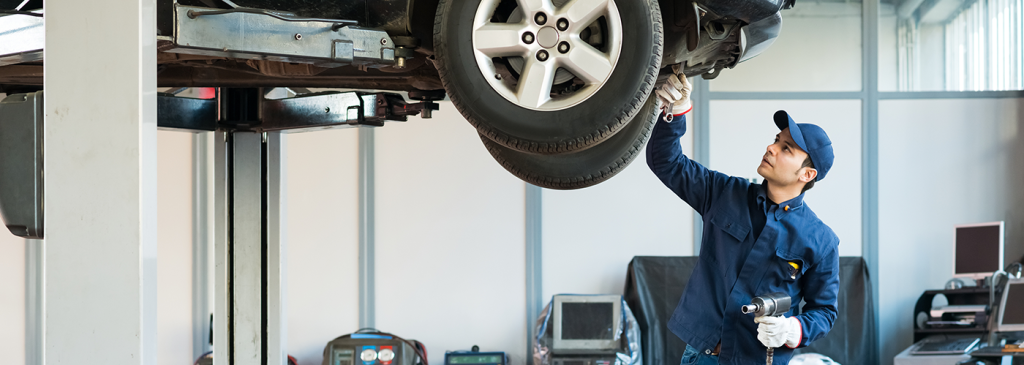
Tires will eventually wear out and should be changed every four to six years. They can also become damaged by incorrect inflation, wheel balance issues, or poor alignment. As your Nissan dealership, we’d like to advise you on some signs you need to visit us for a tire service and possible replacement.
Old Tires
Rubber is the perfect material for vehicle tires, combining strength with flexibility. Unfortunately, rubber slowly loses its flexibility over time due to water, mud, and UV rays. This loss of flexibility causes the rubber to crack. As time passes, the cracks widen and deepen as the rubber heats due to surface friction, then cools when your Nissan is stationary.
Cracks that reach deep enough into the rubber will cause leaks. The cracks are also weaknesses in the rubber and could cause a blowout. We can repair minor leaks to extend tire life, but tire cracks can’t be fixed. Our technicians will examine your tires and advise on their condition. If your tires are severely cracked, replacing them is the safest option and will allow you to drive with confidence that they won’t fail you.
Lincoln Penny Test
The tread is the raised tire section in contact with the surface. It allows the tire to grip the surface, making driving and handling easier. The tread slowly wears down due to surface friction, and you’ll notice your braking distance increases. The minimum safe tread is 2/32″, and you check your tread using a tread depth gauge or a Lincoln penny.
Grab a penny and insert it upside down into the deepest part of the tread. If you can only see part of Lincoln’s face, the tire tread is healthy. If you can see Lincoln’s face up to his hairline, the tread is wearing thin, and the tire will need replacement soon. Finally, if you can see the top of Lincoln’s head, the tread is dangerously low, and that tire needs replacement ASAP. We can quickly replace a worn tire to fix this problem.
Underinflated Tires
The correct inflation for Nissan is listed in your vehicle handbook. This information is also marked on a sticker or plate on the inside door jamb of the front passenger door. Regular tire pressure checks are important, as tire pressure will change naturally by 1 to 2 PSI per 10-degree increase or decrease in temperature.
Underinflated tires droop, exposing part of the softer sidewalls to surface friction. Sidewalls don’t have reinforcement like the tread and will wear faster, causing leaks. We’ll correct your tire inflation and check the tires to determine if they need replacement. Worn tires make driving dangerous. Contact our service department today at Ken Ganley Nissan Mayfield in Mayfield Heights, OH.
Connect with us


- AC Service
- Battery Service
- Brake Service
- Ken Ganley Nissan Mayfield Service
- Mayfield Heights Nissan Dealer
- Mayfield Heights Nissan Service
- Mayfield Heights Used Cars
- Nissan Accessories
- Nissan Altima
- Nissan Ariya
- Nissan Armada
- Nissan Frontier
- Nissan Kicks
- Nissan LEAF
- Nissan Murano
- Nissan Pathfinder
- Nissan Rogue
- Nissan Sentra
- Nissan Titan
- Nissan Versa
- Nissan Z
- Routine Maintenance
- Vehicle Tips